

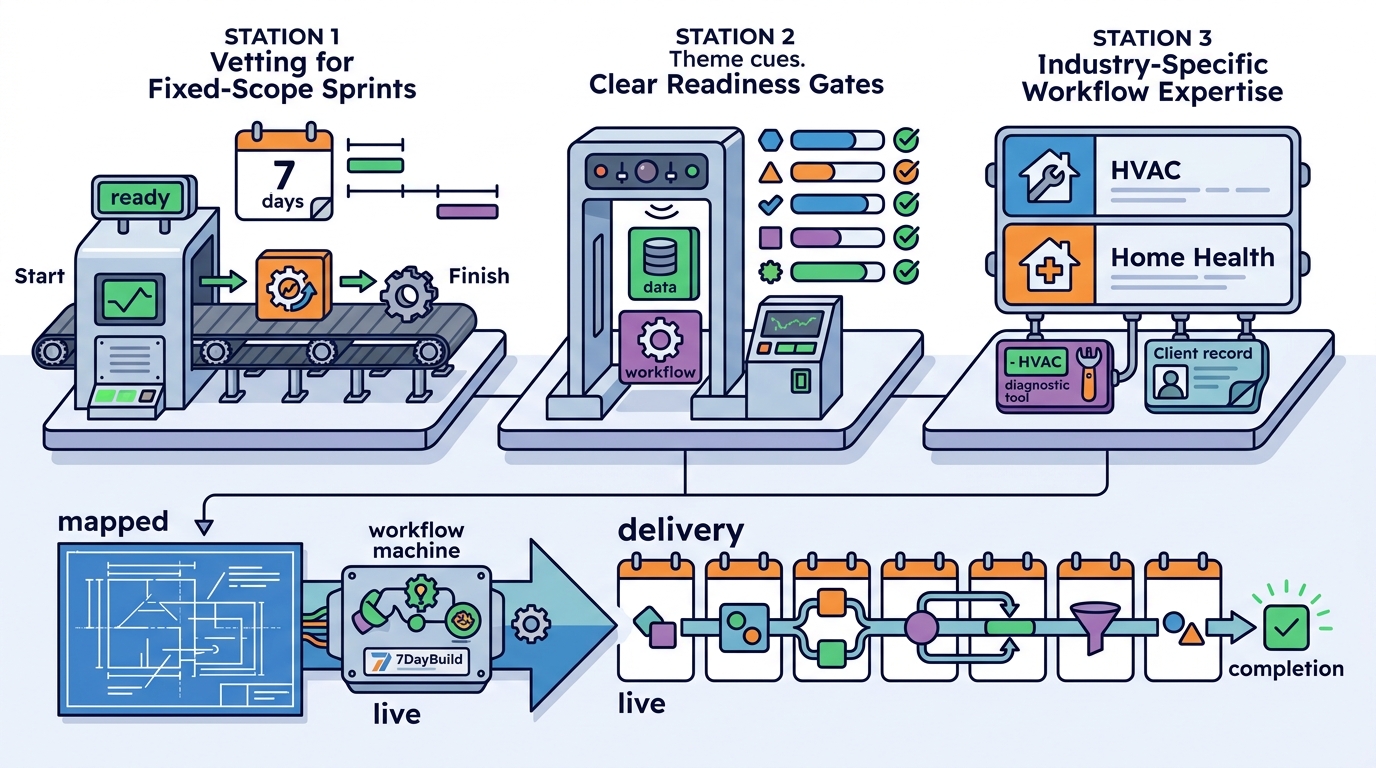
Find a dedicated team by vetting for fixed-scope sprints, clear readiness gates, and industry-specific workflow expertise. The right partner defines a single stuck handoff, maps the current state, and delivers live automation within seven business days of scope approval. This approach removes the ambiguity of open-ended development and ensures your team trains on a working system, not a theoretical prototype.
Vetting Scope and Readiness Gates
Many agencies promise speed but fail to define when the clock actually starts. A dedicated team for rapid automation must distinguish between the initial discovery call and the actual build window. The seven-day timeline typically begins only after scope is signed off, working system access is granted, and a decision-maker is named. This readiness gate protects both the client and the developer. It ensures that the team is not waiting on credentials or approvals while the deadline ticks down.
When evaluating a potential partner, ask specifically about their readiness criteria. Do they require a named owner for the workflow? Do they need write access to your existing tools? A team that builds for field service or healthcare operations will often ask about data handling and access protocols before writing a single line of code. This level of operational rigor is a strong indicator of a team that has delivered live systems before, rather than just demo environments.
Matching Industry-Specific Workflow Expertise
Generic software developers often struggle with the nuances of field service operations. They may build a generic ticketing system that ignores the specific handoffs between dispatch, field technicians, and back-office staff. A dedicated team with sector-specific experience understands that a job request in HVAC or home health is not just a data entry task. It is a chain of dependencies involving authorization, scheduling, and paperwork. This expertise allows the team to anticipate blockers that a generalist would miss.
For example, in home health operations, the intake process often stalls due to missing authorizations or incomplete patient records. A team familiar with this sector knows how to surface these missing documents automatically. They build the logic to flag aging items and notify the right manager without human intervention. This specific knowledge is the difference between a tool that sits unused and one that actually moves work forward. You are hiring for pattern recognition, not just coding speed.
Understanding Fixed-Price Sprint Models
Open-ended hourly billing is the enemy of a one-week build. It creates misaligned incentives where the developer profits from your confusion. A dedicated team operating on a fixed-price sprint model aligns their success with your clarity. They are motivated to define the scope tightly because their compensation is tied to a specific, agreed-upon outcome. This model forces a conversation about what "done" means before the work begins. It eliminates the risk of scope creep that often derails rapid development projects.
Navigating Data Handling and Compliance
Automation in regulated industries like healthcare requires strict data handling protocols. A dedicated team must be transparent about how they access your systems. They should not ask for patient records or customer account details during the initial fit check or discovery phase. Instead, they should use sample data or made-up records to demonstrate the flow. This practice protects your liability and ensures that the team is comfortable working within strict access boundaries. It also signals that they understand the difference between a demo and a production environment.
Ensuring Effective Training and Handoff
A build is not complete when the code is deployed. It is complete when your team can operate it without the developer present. A dedicated team for rapid automation must include structured training as part of the sprint. This is not a one-hour video call; it is a guided walkthrough of the new workflow. The team should provide a written how-to guide that documents the new process. This guide becomes the source of truth for your staff, reducing the reliance on tribal knowledge. It ensures that the automation survives staff turnover and role changes.
Key Takeaways
- Verify that the seven-day timeline starts after readiness is confirmed, not from the first call.
- Look for teams with specific experience in your sector, such as HVAC or home health, to ensure they understand your workflow nuances.
- Prefer fixed-price sprint models over hourly billing to align incentives and prevent scope creep.
- Ensure the team uses sample data for demos and has clear protocols for handling protected information in production.
- Require written documentation and structured training as part of the deliverables to ensure long-term usability.
- Check for a post-sprint review or follow-up window to address any issues that arise after deployment.
Frequently Asked Questions
How long does a typical automation sprint take?
A standard automation sprint typically takes seven business days. This timeline begins once the scope is signed off, access is granted, and a decision-maker is named. It does not include the time spent on initial discovery or fit checks.
Do I need to buy new software for the build?
Not necessarily. A good team will first assess your existing tools. If your current systems can support the workflow, they will build there. If a different system is a better fit, they will recommend it in the blueprint before starting the build.
What happens if the team misses the deadline?
Reputable teams define "done" in writing before starting. If they miss an agreed-upon item that was in their control, they should fix it at no extra labor cost within an agreed window. This is a key term to negotiate in the contract.
Can the team handle patient or customer data?
They should not ask for real patient or customer data during the initial fit check. For live work, access must be agreed upon in writing, with appropriate data handling protocols and agreements in place. This ensures security and compliance.
Is the team responsible for ongoing maintenance?
The sprint typically includes a short period of follow-up fixes. For ongoing maintenance, many teams offer a managed care plan. This is an optional service that includes monitoring, monthly reviews, and small changes to keep the automation running smoothly.
What is the difference between a sprint and a larger project?
A sprint covers one workflow in up to two systems. A larger project involves multiple workflows, more than two systems, or several teams. Larger projects are quoted separately and often involve a phased engagement with a written plan.
Start Your Automation Sprint
7DayBuild specializes in advancing field service operations by automating the handoffs that cause the most friction. We work with home health, HVAC, and other service sectors to move work forward without manual chasing. Our fixed-price sprints are designed to deliver live automation within seven business days of readiness. To see if your workflow is a fit, take the 2-minute fit check or book a free 15-minute Fit Call. We will help you map the process and confirm if it is doable before you commit to a build.