

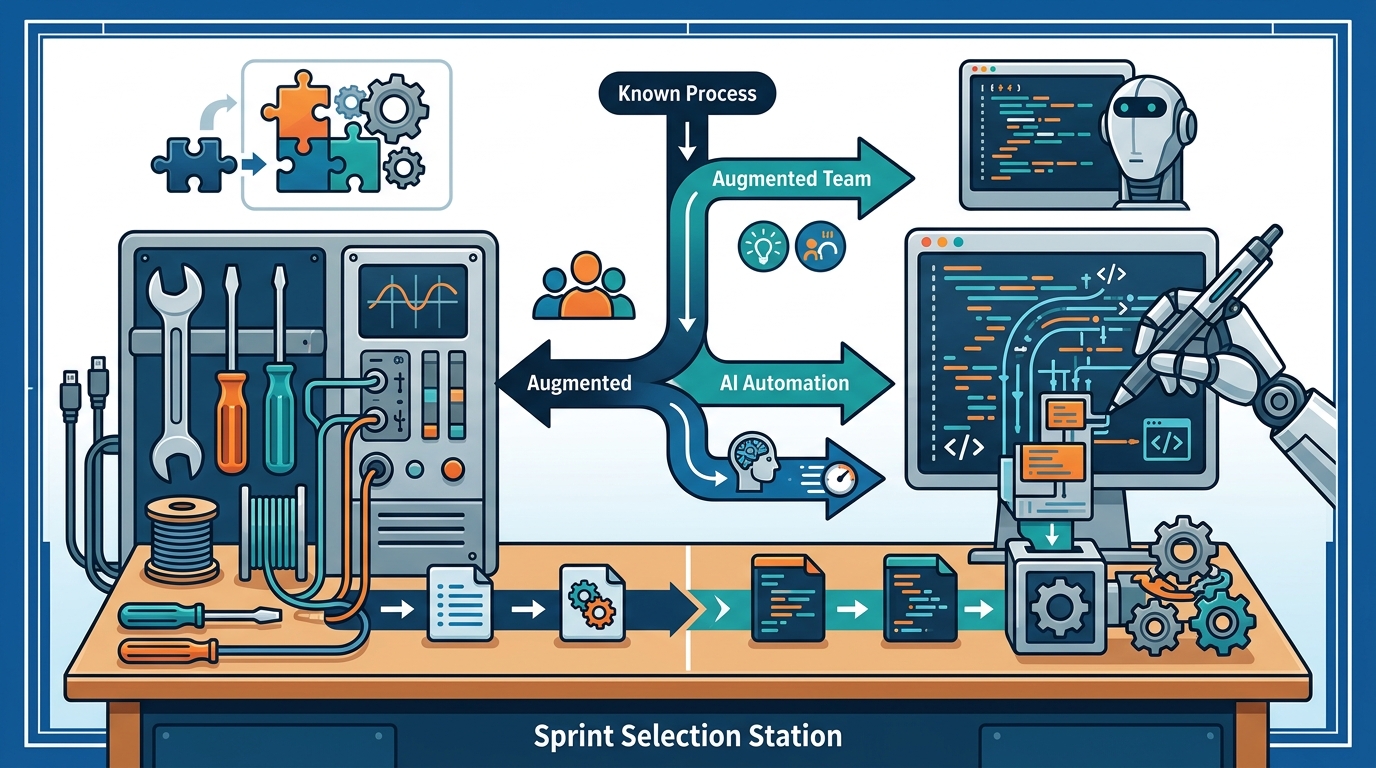
When you already know the process and just need it built, the best rapid product sprint options are dedicated team augmentation and AI-assisted development. This guide covers how to choose between these two approaches, what to expect from each, and how to structure your engagement for speed and clarity. We focus on practical decision-making for operations leaders who need a working system fast without open-ended scope creep.
Dedicated Team Augmentation
Dedicated team augmentation is a service model where a specialized team joins your existing operation to build and deploy specific workflows. This approach works best when you have a clear process map but lack the internal engineering capacity to execute it. The team operates under your direction, using your systems and data, to deliver a functional solution within a fixed timeframe.
Scope and Delivery Structure
In this model, the engagement is typically scoped to one specific workflow or handoff point. The team maps the current state, identifies the bottleneck, and builds the automation or integration needed to move work forward. Delivery is measured in business days after readiness is confirmed, not from the initial discovery call. This distinction is critical for setting realistic expectations.
Why It Works for Known Processes
When you already know the process, you do not need a long discovery phase. You need execution. Dedicated teams bring the technical skills to implement the logic you have already defined. They handle the build, testing, and initial training, allowing your staff to focus on operations rather than software development. This model reduces the risk of scope creep because the deliverable is defined upfront.
AI-Assisted Development
AI-assisted development is a methodology that uses artificial intelligence tools to accelerate coding, testing, and documentation. This approach leverages large language models and automated testing frameworks to reduce the time required for repetitive development tasks. It is particularly effective for standard integrations and data routing where patterns are well-established.
Speed and Efficiency Gains
AI tools can generate boilerplate code, suggest optimization strategies, and automate test case creation. This allows developers to focus on complex logic and edge cases. For teams with known processes, AI assistance can significantly compress the build phase. However, it requires human oversight to ensure the output aligns with business rules and compliance requirements.
Limitations and Human Oversight
AI-assisted development is not a replacement for human judgment. It excels at pattern recognition but struggles with novel business logic or ambiguous requirements. The human developer must validate the AI-generated code, ensure data security, and handle exceptions. This hybrid approach combines the speed of AI with the reliability of human expertise.
Comparison of Sprint Options
The following table summarizes the key differences between dedicated team augmentation and AI-assisted development for rapid product sprints.
| Primary Focus | Execution of defined workflows | Acceleration of coding and testing |
| Best For | Teams with clear process maps | Standard integrations and data routing |
| Human Involvement | High (direction and validation) | Medium (oversight and exception handling) |
| Speed Factor | Fixed timeline after readiness | Variable, depends on tool maturity |
| Risk Profile | Low (scoped deliverables) | Moderate (requires validation) |
Key Takeaways
- Dedicated team augmentation is ideal when you have a clear process but lack internal engineering capacity.
- AI-assisted development accelerates coding and testing but requires human oversight for validation.
- Delivery timelines begin after readiness is confirmed, not from the first conversation.
- Scope clarity is the single biggest factor in sprint success.
- Fixed-price engagements reduce financial risk and align incentives.
- Human expertise remains essential for handling edge cases and compliance.
- Choose the option that matches your team's current technical maturity and process definition.
Frequently Asked Questions
What is the difference between a rapid sprint and a full project?
A rapid sprint focuses on one specific workflow or handoff, delivered in a fixed timeframe. A full project may cover multiple workflows, systems, or teams, with a longer timeline and phased delivery.
How long does a rapid product sprint take?
Timelines vary based on scope and readiness. A typical sprint may take seven business days after scope is signed off and access is granted. The clock starts after readiness is confirmed, not from the initial call.
Do I need to buy new software for a sprint?
Not necessarily. Many sprints build on existing systems. If a new tool is required, it is identified during the planning phase and agreed upon before work begins.
What role does AI play in the build process?
AI tools can accelerate coding and testing tasks. However, human developers validate the output to ensure it meets business rules and security standards.
How is scope defined in a rapid sprint?
Scope is defined upfront, including the specific workflow, systems involved, and success criteria. This prevents scope creep and ensures clear deliverables.
Can I use my existing data for the sprint?
Yes, but data handling must be agreed upon in writing. For sensitive data, appropriate agreements and approvals are required before production work begins.
What happens if the build misses the agreed scope?
If the provider misses something within their control, they fix it at no extra cost within an agreed window. This is typically outlined in the service agreement.
Is AI-assisted development safe for sensitive data?
It can be, if proper data handling protocols are in place. Human oversight ensures that sensitive data is not exposed to unauthorized AI tools.
Conclusion
Choosing the right rapid product sprint option depends on your current readiness and the complexity of the process you need to build. Dedicated team augmentation offers a structured, fixed-price path for teams with clear process maps. AI-assisted development provides speed gains for standard tasks but requires human validation. Both approaches can deliver working solutions quickly when scope is defined and readiness is confirmed. For field service operations looking to move off manual workflows, 7DayBuild offers a structured path to automate stuck handoffs. To explore how a rapid sprint can fit your operation, take the 2-minute fit check or review field service automation options. You can also see pricing for automation Sprints to understand the investment required. For larger initiatives, larger projects are quoted separately after a fit call. View a sample automated flow to see how work moves without manual chasing.