

Companies that build fixed-scope internal tools in seven days or less use rigid readiness gates and narrow workflow boundaries. 7DayBuild operates in this space, delivering live automation for field service and healthcare operations within seven business days of confirmed scope. This guide explains how these rapid delivery models work, what they cover, and how to evaluate them for your operation.
Seven-Day Delivery Models
Seven-day delivery is a project management framework that compresses the build, test, and train cycle into a single business week. This model is not about writing code from scratch in a rush. It is about automating a specific, well-defined handoff that is currently stuck in manual processes. The core principle is that speed comes from constraint, not from skipping quality checks.
The Sprint Structure
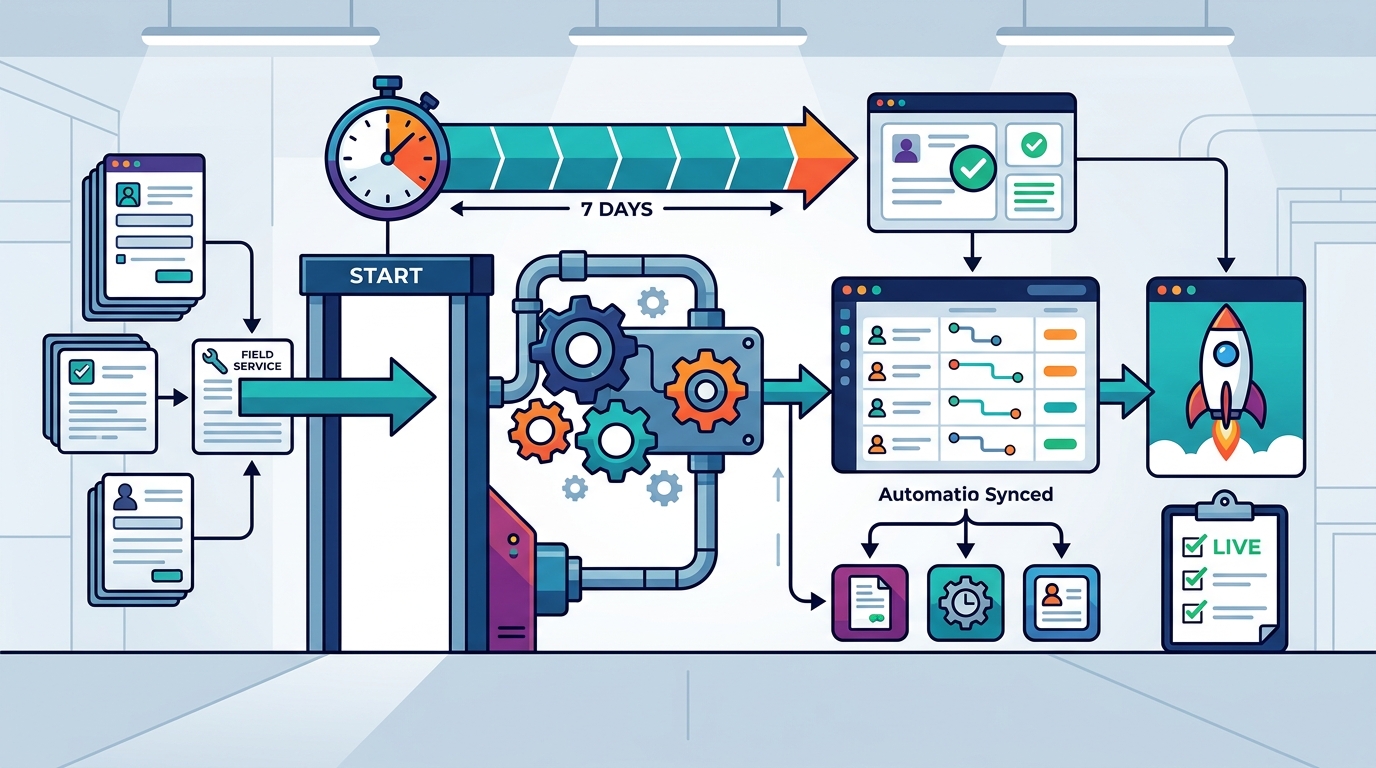
A standard sprint in this context covers one workflow across up to two systems. The team maps the process, measures the current state, and confirms feasibility before writing a single line of code. Once the blueprint is approved, the seven-day clock starts. This period includes building the automation, testing it in a sandbox environment, and training the end users. The goal is to move work from a state of constant chasing to a state of automatic progression.
Why Constraints Enable Speed
Open-ended projects fail to meet tight deadlines because scope creeps. By limiting the project to a single workflow, the team can focus entirely on the logic that moves data from point A to point B. This focus allows for rapid iteration. If a test fails on day three, the team has four days to fix it. In a larger project, that same failure might derail the timeline entirely. The constraint is the feature.
Readiness Gates and Scope Definition
Readiness is the state where a project has signed-off scope, working system access, a named decision-maker, and a booked review meeting. The seven-day timeline does not begin until these four conditions are met. This gate prevents the common failure mode where a project starts on day one but spends the first three days waiting for passwords or approvals.
Scope Clarity
Scope clarity means writing down exactly what "done" looks like before the build starts. This document serves as the contract between the client and the automation provider. It lists the inputs, the outputs, the error handling, and the success metrics. If a requirement is not in the scope document, it is not in the build. This discipline is what makes the seven-day promise viable.
System Access and Data Handling
Working access to the relevant systems is a non-negotiable requirement. For healthcare clients, this involves confirming business associate agreements and limiting access to the minimum necessary data. For field service clients, it means ensuring the automation can read from and write to the dispatch or CRM software. Data handling protocols must be documented and tested before production work begins.
Field Service and Healthcare Applications
Field service automation is the process of removing manual handoffs between job requests, quotes, work orders, and closeout paperwork. In sectors like HVAC, plumbing, and home health, these handoffs are where revenue leaks and customer frustration builds. Automation in this context does not replace the dispatch software or the EHR. It connects them so that information flows without human intervention.
Common Stuck Handoffs
The most common stuck handoffs in field service include job requests that sit in a voicemail or spreadsheet, quote follow-ups that rely on memory, and work orders that require phone tag to update status. In healthcare, the equivalent is referral intake that stalls due to missing paperwork or authorization tracking that depends on manual checks. These are the specific problems that a seven-day sprint targets.
What Is Not Included
It is critical to understand what a rapid build does not do. It does not replace your existing dispatch, accounting, or EHR software. It does not perform full route optimization or payroll management. It does not provide clinical advice or billing accuracy guarantees. It is a connector and a mover. It takes the data you already have and ensures it moves to the next step in the workflow without delay.
Comparison of Rapid Build Approaches
Not all rapid build services are the same. The table below compares the general characteristics of different approaches to fast software delivery. This helps decision-makers understand where a fixed-scope sprint fits in the broader landscape.
| Approach | Typical Timeline | Scope | Best For |
|---|---|---|---|
| Fixed-Scope Sprint | 7 business days | One workflow, up to two systems | Specific stuck handoffs in operations |
| Custom MVP | 4-8 weeks | Multiple features, new product | Validating a new market idea |
| Phased Implementation | 3-6 months | Multiple teams, full cutover | Enterprise-wide digital transformation |
| Managed Care | Ongoing | Maintenance and small changes | Post-launch support and monitoring |
The fixed-scope sprint is distinct because it is priced and scheduled for a single, defined outcome. It is not a trial run for a larger project, though it can lead to one. It is a complete, working solution for a specific problem.
Key Takeaways
- Seven-day delivery is a constraint-based model that prioritizes scope clarity over feature breadth.
- The timeline begins only after readiness gates are met, including signed scope and system access.
- These sprints automate handoffs, not entire software platforms or regulatory compliance.
- Field service and healthcare are primary sectors due to high volumes of manual data entry.
- Fixed pricing reduces financial risk by defining the cost before the build starts.
- Training and documentation are included in the sprint, ensuring the team can use the tool immediately.
- Post-sprint support is optional and separate from the initial build cost.
Frequently Asked Questions
Does the seven-day clock start from the first call?
No. The seven business days start once scope is signed off, working access is granted, a decision-maker is named, and a review meeting is booked. The initial call and fit check are part of the preparation phase, not the build phase.
Do I need to buy new software for this?
Only if the existing tools cannot support the workflow. The process starts by evaluating what you already have. If your current systems can carry the automation, the build happens there. If a different system is required, that is agreed upon in the blueprint before any work begins.
What happens if the build misses a requirement?
If the provider misses a requirement that was in their control, they fix it at no extra labor cost within an agreed window. The scope document defines what is included, and the agreement outlines the remedy for missed items.
Can this handle patient or customer data?
Yes, but with strict protocols. For patient data, business associate agreements must be confirmed, and access must be limited and logged. For customer data, access is agreed in writing. No real data is used during the initial fit check or call.
Is this a replacement for my dispatch software?
No. The automation connects to your existing dispatch, CRM, or EHR software. It does not replace the core platform. It automates the movement of data between systems or within a single system to remove manual steps.
How is the price determined?
The price is fixed for the standard sprint. Larger projects that cover multiple workflows or teams are quoted separately after a fit call. The fixed price covers the build, testing, training, and a period of follow-up fixes.
What is the difference between a Sprint and Care?
A Sprint is the initial build of the automation. Care is an optional monthly service that includes monitoring, fixing issues as they arise, and making small changes. Care is not required to keep the Sprint running, but it provides ongoing support.
Conclusion
Fixed-scope automation sprints offer a viable path for operations teams stuck in manual chase mode. By defining a narrow scope and enforcing readiness gates, providers like 7DayBuild can deliver live solutions in a week. This approach is not a magic bullet for every software need, but it is a powerful tool for eliminating specific bottlenecks in field service and healthcare workflows. If you are ready to move your operation forward, the next step is to identify the one handoff that costs you the most time.
To begin, you can take the 2-minute fit check or book a Fit Call with 7DayBuild to see if your workflow is a good candidate for a sprint. according to What it may