

Turning a stalled internal workflow into working software in one week is possible when you isolate a single bottleneck, define strict acceptance criteria, and execute in daily deployment cycles. This guide explains how 7DayBuild structures rapid automation projects for field service and healthcare operations. We cover scope definition, bottleneck isolation, daily cycles, and acceptance criteria to help you move from manual chasing to automated flow. For additional details, review the Take the 2 minute.
MVP Scope Definition
Why Scope Creep Kills One-Week Builds
Scope creep is the gradual expansion of project requirements beyond the original plan. It is the primary reason rapid development projects fail. When you try to solve five problems in seven days, you solve none of them well. 7DayBuild operates on a fixed-scope model. We take on a limited number of projects at a time to ensure deep focus. The scope is defined before the clock starts. If the scope is too broad, the project is not a one-week build. It is a larger project that requires a different engagement model.
Defining the Boundaries
Clear boundaries are essential. You must define what the software will do and, equally importantly, what it will not do. For example, an automation for job scheduling might not include payroll integration or full route optimization. By explicitly excluding these features, you protect the timeline. The goal is to get the core workflow moving. You can expand the system later, but the first build must be tight and focused.
Bottleneck Isolation
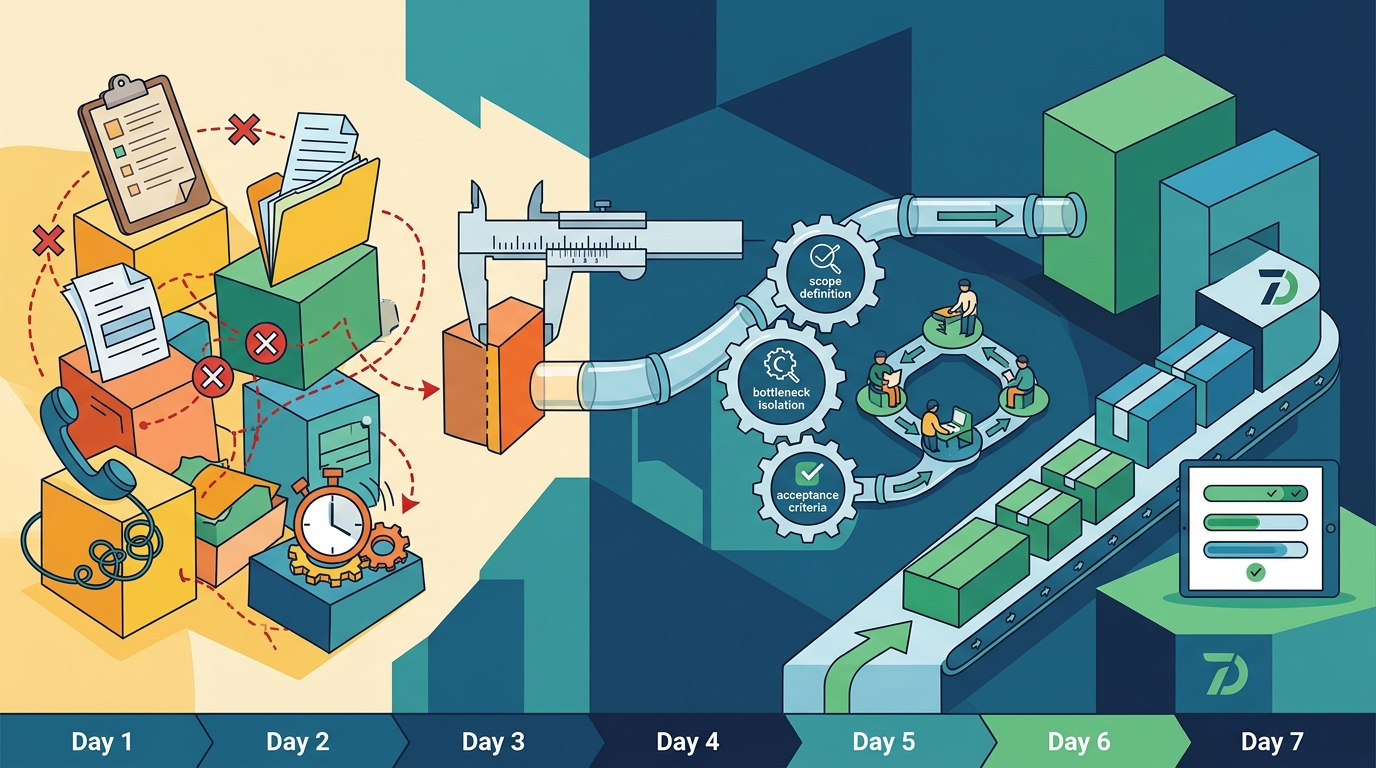
Bottleneck isolation is the practice of identifying the single point of failure or delay in a process and addressing it in isolation. Most operational stalls are not caused by a lack of effort. They are caused by a specific handoff where information gets stuck. This could be a voicemail that goes unanswered, a spreadsheet that is not updated, or a document that is missing. By isolating this bottleneck, you can build a targeted solution that moves work forward without overhauling the entire operation.
Identifying the Stuck Handoff
To isolate a bottleneck, you need to map the current state of your workflow. Look for where work waits. Is it waiting for a manager approval? Is it waiting for a customer response? Is it waiting for a system update? 7DayBuild starts by mapping the process and measuring where it stands today. This measurement phase is critical. It provides a baseline against which you can measure the success of the automation. If you cannot measure the problem, you cannot prove that the solution works.
Why Isolation Works
Isolation works because it reduces complexity. A complex system with many moving parts is hard to debug and hard to deploy quickly. A simple system with one clear input and one clear output is easy to build and test. By focusing on one stuck handoff, you create a clear success metric. Did the work move? If yes, the automation is working. If no, you can quickly identify why and fix it. This iterative approach is the core of rapid deployment.
Daily Deployment Cycles
Daily deployment cycles are a development methodology where working software is delivered and tested every day. In a seven-day sprint, this means you have seven opportunities to show progress and adjust course. This approach reduces risk. If something is not working on day three, you have four days to fix it. If you wait until day seven to show the final product, you have no time to recover from a major issue. Daily cycles keep the client and the developer aligned.
The Role of the Fit Call
The Fit Call is the initial conversation where you discuss what is stuck, who owns it, and what access is needed. This call is free and takes 15 minutes. It is not a sales pitch. It is a diagnostic. The goal is to determine if the project is a good fit for a rapid sprint. If the scope is too large or the systems are too complex, the Fit Call will say so. This honesty saves time and money for both parties. It ensures that the seven-day clock only starts when the project is ready for rapid execution.
Access and Readiness
Readiness is a critical factor in daily deployment cycles. The seven business days start once scope is signed off, working access to your systems is granted, one decision-maker is named, and a review meeting is booked. If access is delayed, the clock is delayed. This is not a penalty. It is a reality of software development. You cannot build in a system you cannot access. By confirming readiness before the sprint begins, you ensure that the daily cycles can actually happen.
Acceptance Criteria Definition
Writing Testable Criteria
Good acceptance criteria are specific and measurable. Avoid vague language like "the system should be fast" or "the interface should be user-friendly." Instead, use concrete metrics. "The page loads in under 2 seconds" or "The user can complete the form in under 3 clicks." These criteria can be tested automatically or manually. They provide a clear checklist for the final review. If a criterion is not met, the feature is not done. This discipline ensures that the software delivered is actually useful.
Agreeing on "Done"
Agreeing on "done" is a collaborative process. The client and the developer must align on what the final state of the workflow should look like. This agreement is documented in the Blueprint. The Blueprint is a fixed-price document that maps the process, measures the current state, confirms feasibility, and writes down what "done" means. It is the contract for the sprint. By having this document, you eliminate ambiguity. You know exactly what you are paying for and what you will receive.
| Phase | Key Activity | Outcome |
|---|---|---|
| Fit Call | Diagnostic conversation | Go/No-Go decision |
| Blueprint | Process mapping and scope definition | Fixed quote and acceptance criteria |
| Sprint | Daily build and test cycles | Live automation in 7 business days |
| Care | Ongoing monitoring and fixes | Sustained workflow stability |
Key Takeaways
- Rapid software builds require strict scope definition to avoid creep.
- Isolating a single bottleneck is more effective than overhauling the entire process.
- Daily deployment cycles reduce risk and allow for quick course corrections.
- Acceptance criteria must be objective and testable to prevent disputes.
- Readiness, including system access and decision-maker availability, is a prerequisite for the seven-day timeline.
- The Fit Call is a diagnostic tool, not a sales pitch, ensuring project fit.
- 7DayBuild focuses on one stuck handoff per sprint to ensure deep focus and quality.
- Clear documentation of "done" is essential for successful project closure.
Frequently Asked Questions
How long does the seven-day sprint actually take?
The seven business days start once scope is signed off, we have working access to your systems, one decision-maker is named, and a review meeting is booked. The timeline does not start from the first call. It starts when the project is ready for execution.
Do I need to buy new software?
Only if that is the clearer path. We start by looking at what you have. If your existing tools can carry the workflow well, we build there. If a better system is the right move, we say so in the Blueprint and agree before anything is built.
What happens if the scope is too large for a one-week build?
If the project covers more than one workflow, more than two systems, or several teams, it is quoted separately as a larger project. We do not force a large scope into a one-week sprint. We recommend the appropriate engagement model for the size of the work.
Do you need patient or customer information for the Fit Call?
No. Please do not send patient names, medical record numbers, chart notes, or customer account details for the Fit Call or fit check. Access for live work is agreed in writing first, with least-privilege principles applied.
What is included in the 7 Day Workflow Sprint?
The sprint includes building and testing one workflow in up to two systems, training your team, providing a written how-to guide, 14 days of follow-up fixes, and a day-30 review.
Can you handle healthcare-specific compliance?
7DayBuild provides product and workflow build services only. We do not provide legal, clinical, billing, or compliance advice. Any tools involving patient or protected information require appropriate agreements and data-handling approvals before production work begins.
Conclusion
Turning a stalled workflow into working software in one week is a matter of discipline, not magic. It requires clear scope, isolated bottlenecks, daily cycles, and strict acceptance criteria. 7DayBuild is built for this specific type of rapid deployment. We help field service and healthcare operations move off manual chase mode by automating the handoff that costs them the most. If you are ready to stop chasing and start moving, the first step is a conversation. To plan your visit, for a free Fit Call.