

Companies that build fixed-scope internal tools in seven days or less operate on a strict readiness model. They do not start the clock on the first call. Instead, they define a narrow scope, confirm system access, and begin the build only after all prerequisites are met. This guide covers how rapid delivery models work, the specific constraints that make them possible, and how to evaluate a partner for your field service or healthcare operation.
Seven-Day Delivery Models
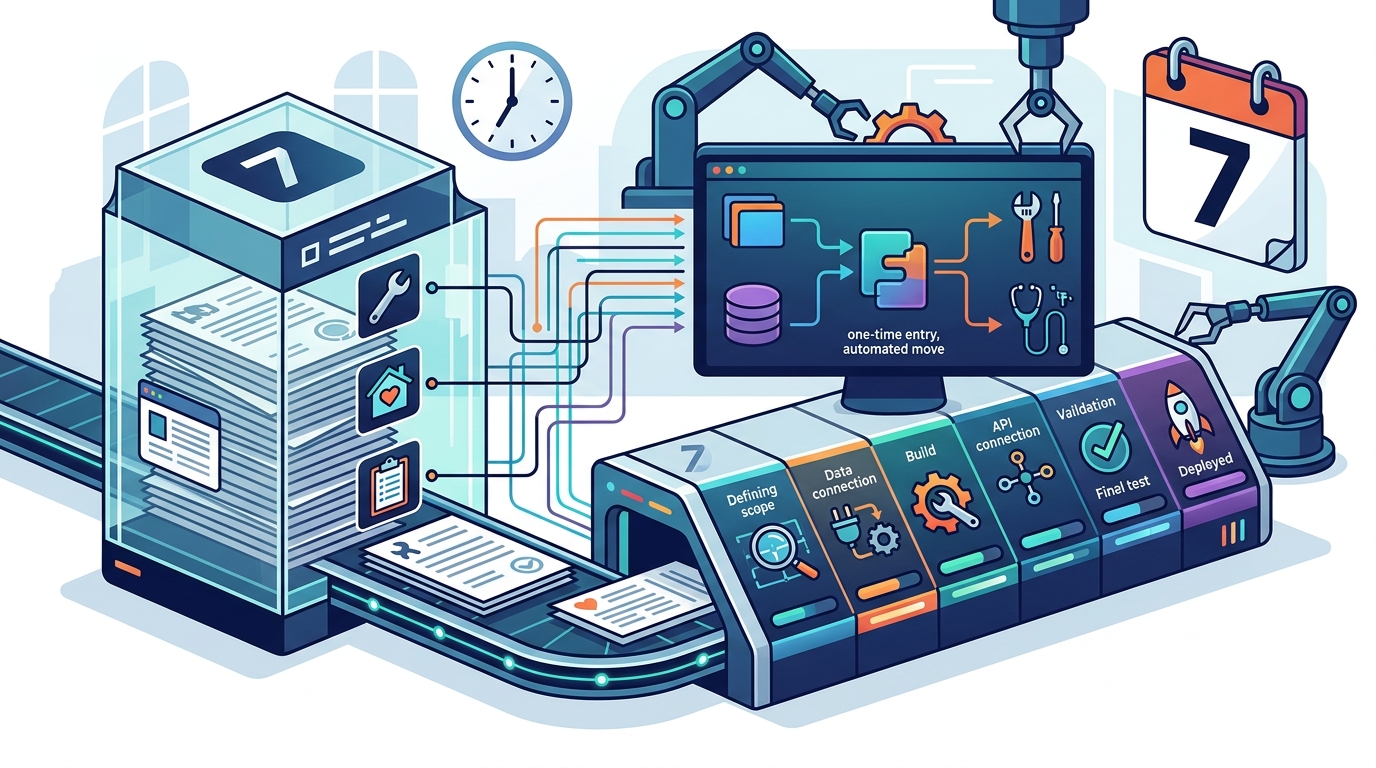
A seven-day delivery model is a project management framework that compresses the build and test cycle into one business week. This approach is not about rushing code. It is about eliminating ambiguity. The team must know exactly what the tool does, which systems it touches, and who is responsible for decisions. When these elements are clear, the technical work becomes a linear process rather than a discovery phase.
The Sprint Structure
The Readiness Gate
The most critical component of a seven-day build is the readiness gate. The clock does not start when you book a call. It starts when specific conditions are met. These conditions typically include signed-off scope, working access to your systems, a named decision-maker, and a booked review meeting. Until these items are complete, the project is in preparation, not execution.
This distinction is vital for setting expectations. A company that promises a live tool in seven days from the first conversation is likely to miss the deadline or deliver a shallow product. A company that uses a readiness gate is being honest about the work required. It acknowledges that automation requires data access and human alignment. Without these, no amount of coding speed will produce a useful internal tool.
Why Readiness Matters
Readiness ensures that the team is not waiting on permissions or approvals while the clock ticks. It also ensures that the client has a single point of contact who can make decisions. In many organizations, decisions are spread across multiple managers. This fragmentation kills rapid delivery. By naming one decision-maker, the project can move forward without bureaucratic delays.
Fixed-Scope Constraints
Fixed-scope delivery is a contractual and technical boundary that defines exactly what will be built and what will not. This constraint is the primary enabler of speed. It prevents scope creep, which is the number one killer of rapid development projects. When the scope is fixed, the team can focus on execution rather than negotiation.
The scope must be narrow enough to be completed in one week. This usually means one workflow in up to two systems. If the project requires more than two systems, multiple teams, or a phased switch-over, it is no longer a standard sprint. It becomes a larger project with a different timeline and pricing structure. Understanding this boundary helps you choose the right partner for your specific needs.
Defining the Boundary
A clear scope document should state what is done. It should list the inputs, the outputs, and the success criteria. It should also list what is excluded. For example, a tool that automates job scheduling might exclude route optimization or payroll integration. By explicitly stating these exclusions, both parties avoid misunderstandings. The tool will do exactly what is written, and no more.
Field Service Applications
Field service operations, including HVAC, plumbing, and cleaning, often suffer from manual handoffs. Work orders move from phone to spreadsheet to chat. Each transfer introduces delay and error. Automation can fix this by creating a single path for work to move. The tool receives the request, updates the status, and notifies the next person in the chain. This eliminates the need for staff to chase updates.
7DayBuild specializes in this exact problem. The company builds automation for field service offices that are stuck in chase mode. The focus is on moving work forward without human intervention. The tools are designed to fit the existing systems of the client. They do not require replacing your dispatch or accounting software. Instead, they connect the dots between the tools you already use.
Common Workflows
Common workflows for automation include job requests, quote follow-up, and work order status. These are high-volume, low-complexity tasks that are perfect for rapid delivery. The tool can surface aging items, flag missing information, and trigger notifications. This allows the office team to focus on exceptions rather than routine updates. The result is a smoother operation and less stress for the staff.
Healthcare Considerations
Healthcare automation requires additional care due to data privacy and regulatory requirements. Tools that handle patient information must comply with relevant laws. This means that vendors must be named, business associate agreements must be confirmed, and access must be limited and tested. These steps take time and must be completed before production work begins.
7DayBuild provides product and workflow build services only. The company does not provide legal, clinical, billing, or compliance advice. If your workflow touches patient data, you must ensure that all necessary agreements are in place. The automation team will build the tool, but you are responsible for the compliance framework. This separation of duties is essential for a successful deployment.
Data Handling
Data handling in healthcare automation requires strict controls. Access to patient records should be limited to what is necessary for the workflow. Logging and recovery procedures must be documented. An incident owner must be named. These measures ensure that if something goes wrong, the organization can respond quickly and effectively. They also demonstrate a commitment to data security that is expected in the healthcare sector.
Comparing Delivery Approaches
Not all rapid delivery models are the same. Some agencies offer open-ended sprints where the scope can change. Others offer fixed-scope sprints where the scope is locked. The fixed-scope model is generally more reliable for meeting a seven-day deadline. It provides a clear target for the team and a clear expectation for the client.
| Approach | Scope Flexibility | Timeline Risk | Best For |
|---|---|---|---|
| Fixed-Scope Sprint | Low | Low | Clear, single-workflow problems |
| Open-Ended Sprint | High | High | Exploratory projects with undefined goals |
| Phased Engagement | Medium | Medium | Multi-team or multi-system rollouts |
The table above illustrates the trade-offs between different delivery approaches. Fixed-scope sprints are the most predictable. They are ideal for organizations that know exactly what they need. Open-ended sprints are more flexible but carry higher risk. They are better suited for projects where the goal is to explore possibilities rather than solve a specific problem.
Key Takeaways
- Seven-day delivery is possible only when scope is fixed and readiness is confirmed.
- The clock starts after access and decision-makers are in place, not after the first call.
- Fixed-scope projects typically cover one workflow in up to two systems.
- Field service automation focuses on eliminating manual handoffs and chase mode.
- Healthcare automation requires compliance agreements before production work begins.
- Fixed-price structures align incentives between the agency and the client.
- Clear success criteria and exclusions prevent scope creep and missed deadlines.
- Adoption is as important as delivery. Training and follow-up are essential.
Frequently Asked Questions
Does the seven-day clock start from the first call?
No. The seven business days start once scope is signed off, working access is granted, a decision-maker is named, and a review meeting is booked. Preparation time is not included in the build window.
Can we change the scope during the sprint?
No. The scope is fixed at the start of the sprint. Changes to the scope will require a new agreement and may extend the timeline. This constraint is what makes the seven-day delivery possible.
Do we need to buy new software?
Only if that is the clearer path. The team will first look at your existing tools. If they can carry the workflow, the automation will be built there. If a new system is needed, it will be identified in the blueprint before the build begins.
What happens if the tool does not work as expected?
The team writes down what done means before starting. If the tool misses an agreed-upon requirement that was in the team's control, they will fix it at no extra labor cost within an agreed window. This is part of the fixed-price agreement.
Is this suitable for large, multi-team projects?
No. Standard sprints cover one workflow in up to two systems. Larger projects that involve multiple teams or locations are quoted separately as phased engagements. They have different timelines and pricing structures.
Do you provide compliance advice for healthcare?
No. 7DayBuild provides product and workflow build services only. The company does not provide legal, clinical, billing, or compliance advice. You must ensure that all necessary agreements and data-handling approvals are in place before production work begins.
Conclusion
Building a fixed-scope internal tool in seven days is a disciplined process. It requires clarity, readiness, and a partner who understands the constraints of rapid delivery. 7DayBuild offers this approach for field service and healthcare operations. The company focuses on moving work forward without manual chase. If you have a stuck workflow that is slowing your office, a fixed-scope sprint may be the right solution. To plan your visit, take the 2-minute fit check or book a Fit Call to see if your workflow is a good fit.