

Turning a stalled internal workflow into working software in one week is possible when you isolate a single bottleneck, define strict acceptance criteria, and execute in daily deployment cycles. This guide explains the exact process 7DayBuild uses to move field service and healthcare operations off manual chase mode. It covers scope definition, bottleneck isolation, daily cycles, and acceptance criteria to ensure your team has a live, tested system within seven business days of readiness.
MVP Scope Definition
Why Scope Creep Kills One-Week Builds
Scope creep is the gradual expansion of project requirements beyond the original plan. It is the primary reason one-week builds fail. When a team tries to fix intake, scheduling, and billing simultaneously, the complexity multiplies. 7DayBuild enforces a strict boundary: the build covers one workflow in up to two systems. This constraint ensures that the team can map, build, test, and train within the seven business day window.
Mapping the Current State
Before writing code, you must measure where the workflow stands today. This involves tracking time in queue, unassigned counts, and missing documents. By establishing a baseline, you can prove that the new automation actually advances the operation. The scope document must clearly state what is out of bounds, such as payroll, route optimization, or full schedule optimization, to prevent distraction.
Bottleneck Isolation
Bottleneck isolation is the practice of identifying the single point of failure in a process where work accumulates or stalls. In many home health and HVAC offices, the bottleneck is not the technicians, but the office staff who must manually chase status updates. Isolation requires you to stop looking at the whole process and focus on the specific handoff that costs the most time.
Identifying the Costliest Handoff
Not all bottlenecks are equal. You must prioritize the handoff that has the highest financial or operational impact. For a home health agency, this is often referral intake, where a fax or portal referral waits for someone to notice it. For an HVAC company, it might be quote follow-up, where estimates sit in a spreadsheet until Friday. By isolating this specific point, you ensure the automation delivers immediate value.
Defining the Trigger and Action
Once the bottleneck is isolated, define the trigger and the action. The trigger is the event that starts the workflow, such as a new email or a form submission. The action is what the software does next, such as routing the item to a specific queue or sending a notification. This clarity is essential for building a reliable automation that moves work without human babysitting.
Daily Deployment Cycles
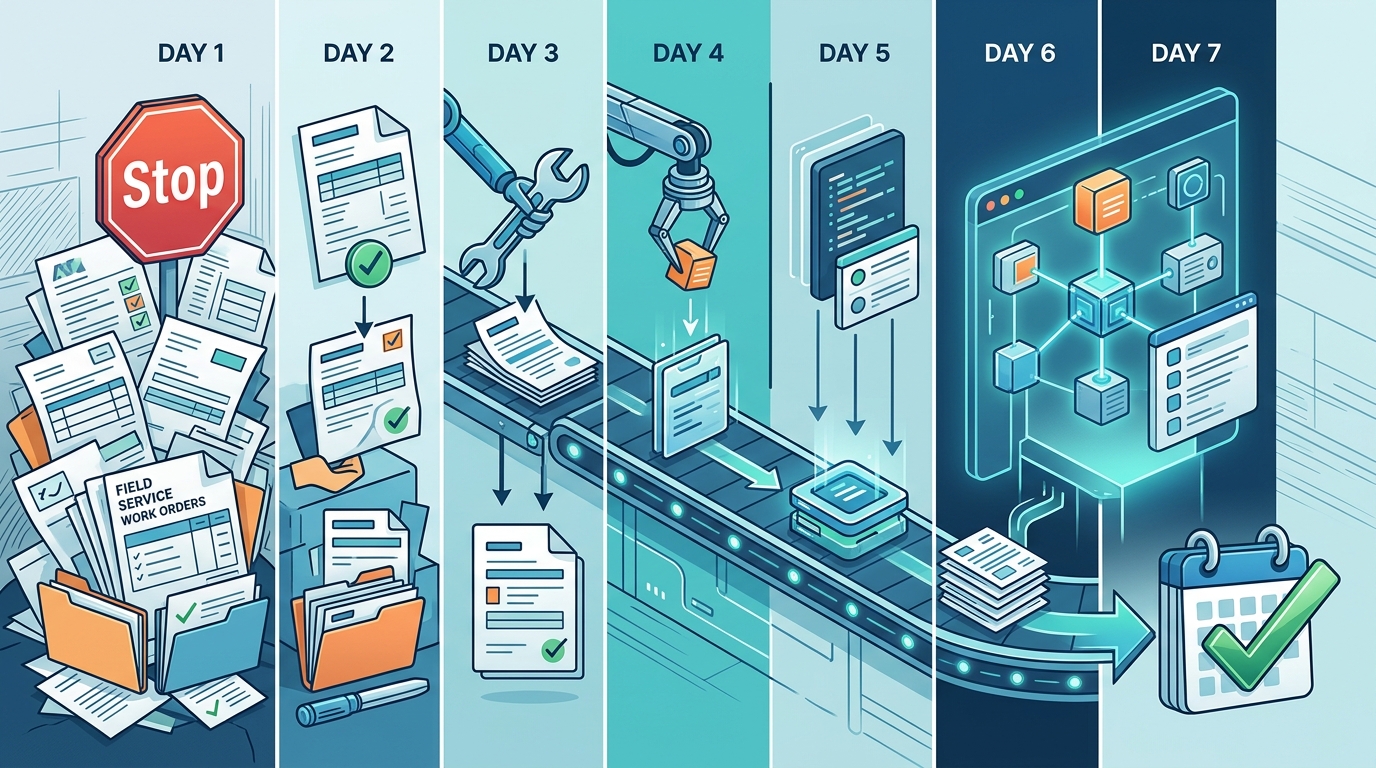
Daily deployment cycles are the iterative process of building, testing, and reviewing software in short, frequent intervals rather than one large release. In a seven-day sprint, this means the team works in tight loops to ensure progress is visible and correctable. This approach reduces risk because issues are caught early, not at the end of the week.
The Seven-Day Sprint Structure
Training and Documentation
Deployment is not just about code; it is about adoption. The team must train the office staff on how to use the new system. This includes providing a written how-to guide and conducting live sessions. The goal is to ensure that the workflow runs as a guided flow, not tribal knowledge. This reduces the learning curve and ensures the automation sticks after the sprint ends.
Acceptance Criteria Definition
Acceptance criteria definition is the process of writing down exactly what "done" means for a software feature. These criteria are objective, testable statements that the client and the developer agree on before work begins. For example, an acceptance criterion might be: "When a new job request is received, it appears in the active queue within 60 seconds."
Writing Testable Criteria
Testable criteria are specific and measurable. They avoid vague language like "improve speed" or "make it user-friendly." Instead, they focus on observable outcomes. This clarity is crucial for the final review, where the team demonstrates that each criterion has been met. If a criterion is missed, the team fixes it at no extra labor cost within an agreed window.
Aligning on Success Metrics
Success metrics are the data points used to evaluate the workflow after deployment. These might include time in queue, unassigned count, or missing documents. By aligning on these metrics upfront, both parties have a shared understanding of what success looks like. This prevents disputes during the final review and ensures the automation is delivering the intended value.
Key Takeaways
- Scope definition must limit the build to one workflow in up to two systems to ensure feasibility within seven days.
- Bottleneck isolation focuses on the single handoff that costs the most time, such as referral intake or quote follow-up.
- Daily deployment cycles reduce risk by allowing for frequent testing and feedback throughout the sprint.
- Acceptance criteria must be objective and testable to prevent disputes during the final review.
- Training and documentation are critical for adoption, ensuring the workflow runs as a guided flow.
- Success metrics should be aligned upfront to provide a clear measure of the automation's impact.
- The seven-day clock starts only after scope is signed off, access is confirmed, and a decision-maker is named.
Frequently Asked Questions
How long does the seven-day sprint actually take?
The seven business days start once scope is signed off, we have working access to your systems, one decision-maker is named, and a review meeting is booked. It does not start from the first call.
Do I need to buy new software for this?
Only if that is the clearer path. We start by looking at what you have. If your current tools can carry the workflow well, we build there. If a better system is the right move, we say so in the Blueprint and agree before anything is built.
What happens if the build misses an acceptance criterion?
We write down what "done" means before we start. If we miss something that was in our control, we fix it at no extra labor cost within an agreed window. Full terms are in the agreement.
Can you handle patient or customer data?
Not for the Fit Call or the fit check. Please do not send patient names, medical record numbers, chart notes, or customer account details. Access for live work is agreed in writing first, and appropriate agreements are confirmed before production work begins.
What is included in the training?
The sprint includes training your team, a written how-to guide, and 14 days of follow-up fixes. The goal is to ensure your team can run the workflow independently after the sprint ends.
Is this suitable for larger projects?
A project is bigger than one Sprint when it covers more than one workflow, more than two systems, several teams or locations, or a phased switch-over. We quote that separately after a Fit Call.
Conclusion
Turning a stalled workflow into working software in one week requires discipline in scope, isolation, and execution. By defining a clear MVP scope, isolating the costliest bottleneck, executing in daily cycles, and setting strict acceptance criteria, you can move your operation off chase mode. 7DayBuild specializes in this rapid deployment model for field service and healthcare businesses. To start, you can take the 2-minute fit check or book a Fit Call to discuss your specific workflow. If you are in healthcare, see our healthcare automation services, or if you are in field service, explore our field service solutions. For larger needs, view our larger project options.