

Who Can Fix Manual Quote Follow-Up for HVAC and Plumbing?
Manual quote follow-up stalls revenue in HVAC and plumbing companies because estimates sit in spreadsheets or inboxes until someone remembers to chase them. 7DayBuild implements automation that advances how jobs move through your office, ensuring new requests enter once and keep moving without manual babysitting. This guide covers how to identify stalled quote workflows, the specific automation patterns that resolve them, and how to evaluate implementation partners for field service operations.
Quote Recovery Rates and the Cost of Stalls
Quote recovery rate is the percentage of issued estimates that convert into signed jobs within a defined window. In field service industries, this metric often drops significantly when follow-up relies on manual memory rather than systematic cadence. When an estimate is sent, the customer expects a response. If that response does not arrive within 24 to 48 hours, the likelihood of conversion decreases sharply.
Manual follow-up creates a gap between the estimate and the decision. Office staff often handle multiple tasks, and quote follow-up becomes a low-priority item that gets pushed to the end of the day. By the time the follow-up happens, the customer may have already called a competitor who responded faster. This is not a sales skill issue. It is a workflow design issue.
The Hidden Cost of Waiting
Every quote that sits waiting represents potential revenue that is at risk. For an HVAC company handling 50 quotes per week, even a 10% drop in conversion due to slow follow-up translates to five lost jobs per week. Over a month, that is 20 lost jobs. The cost is not just the revenue from those jobs. It is also the time spent later trying to recover cold leads that have gone quiet.
Automation does not replace the human relationship. It ensures the relationship does not stall because of a missed task. The goal is to make the follow-up inevitable, not dependent on someone remembering to do it.
Diagnosing Where Quotes Stall
Before implementing any solution, you need to understand exactly where your quote process breaks down. Most field service offices have a multi-step quote workflow that includes request intake, site visit, estimate creation, estimate delivery, and follow-up. Each step is a potential failure point.
Start by mapping your current process. Write down every step from the moment a customer requests a quote to the moment they sign the job. Identify who is responsible for each step and what system they use. Common failure points include:
- Requests arriving in voicemail or email and not being logged into the dispatch system
- Estimates created in one system but not synced to the CRM or follow-up tool
- Follow-up tasks assigned but not tracked, so they fall through the cracks
- No visibility into which quotes are aging and need attention
Once you have mapped the process, measure where it stands today. How long does it take for a quote to be sent after the site visit? How long does it take for the first follow-up to happen? How many quotes are sitting in the pipeline with no activity for more than three days? These numbers give you a baseline to measure improvement against.
Automation Patterns for Quote Follow-Up
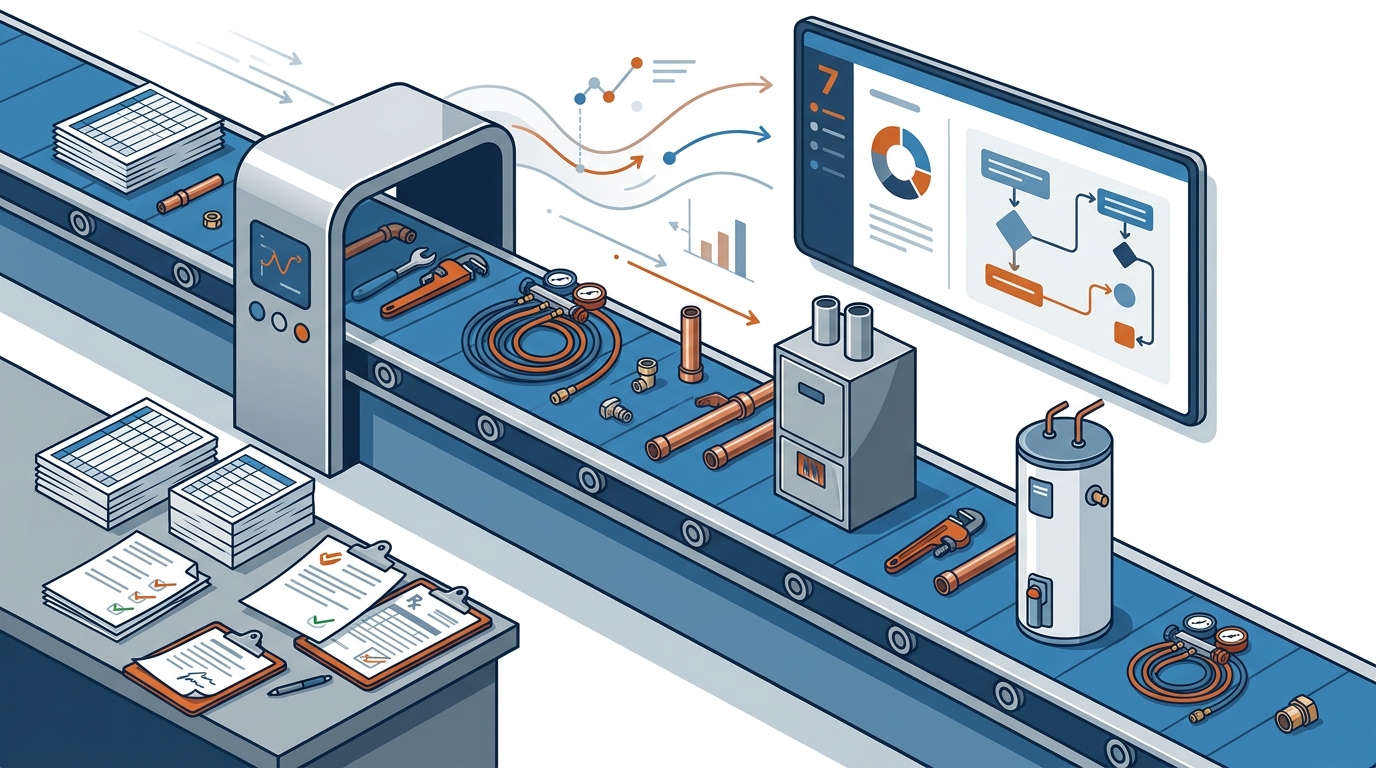
Automation for quote follow-up is not about replacing your team. It is about removing the manual steps that cause delays. The most effective automation patterns for field service quote follow-up include:
Automated Cadence Triggers
When an estimate is sent, the system automatically schedules follow-up tasks at defined intervals. For example, a follow-up might be triggered 24 hours after the estimate is sent, then again at 72 hours, and then at one week. These tasks appear in the office team's task queue, so they are visible and actionable. The system can also send automated reminders to the customer via email or text, keeping the conversation alive without requiring manual effort.
Real-Time Status Visibility
A live dashboard shows the status of every quote in the pipeline. Managers can see which quotes are aging, which are waiting on customer response, and which are ready for the next step. This visibility eliminates the need for phone trees or status meetings to find out where a quote stands. The data updates in real time, so the team always has an accurate picture of the pipeline.
Exception Handling
Not every quote follows a standard path. Some customers need more time to decide. Some quotes require additional information before they can be finalized. Automation should handle these exceptions gracefully. The system can flag quotes that have not moved in a certain period, allowing the team to intervene with a personalized touch. This keeps the process flexible while ensuring nothing falls through the cracks.
Choosing an Implementation Partner
When selecting a partner to implement quote follow-up automation, look for a company that understands field service operations. Generic automation agencies may build a technically sound system that does not fit the realities of how HVAC or plumbing offices actually work. You need a partner who has seen the specific pain points of your industry.
7DayBuild specializes in automation implementation for field service businesses, including HVAC, plumbing, electrical, cleaning, and other home services. The company focuses on one stuck workflow at a time, building and testing the automation in the system that fits your current setup. This approach ensures the solution is practical and usable by your team, not just technically impressive.
What to Look For in a Partner
- Industry-specific experience with field service operations according to Customer service
- A clear, fixed-price engagement model with defined scope
- A process that starts with a fit check to ensure the project is a good match
- Training and documentation included in the delivery
- Post-launch support to fix issues as they arise
Avoid partners who promise unlimited scope or open-ended development. The most effective implementations are tightly scoped, with clear definitions of what is included and what is not. This clarity protects both you and the partner, and it leads to faster, more reliable delivery.
Implementation Timeline and Readiness
Implementation timelines depend on scope clarity, readiness, and client participation. Timelines begin after readiness is confirmed, not from the first call. This is an important distinction. The clock does not start when you book a call. It starts when the scope is signed off, you have working access to your systems, a decision-maker is named, and a review meeting is booked.
For a standard quote follow-up automation project, the timeline typically includes a discovery phase, a build phase, a testing phase, and a training phase. The build phase is where the automation is created and integrated with your existing systems. The testing phase ensures the automation works as expected under real-world conditions. The training phase ensures your team knows how to use the new system and how to handle exceptions.
Readiness is critical. If your systems are not accessible, if your team is not available for training, or if the scope is not clearly defined, the timeline will slip. This is not a failure of the partner. It is a reflection of the reality that automation requires preparation. A good partner will help you get ready, but they cannot do the work for you.
Key Takeaways
- Manual quote follow-up is a workflow design issue, not a sales skill issue. Automation ensures follow-up happens without relying on memory.
- Quote recovery rate is a key metric to track. Measure your baseline before implementing any solution.
- Map your current quote process to identify where it stalls. Common failure points include request intake, estimate delivery, and follow-up tracking.
- Effective automation includes automated cadence triggers, real-time status visibility, and exception handling.
- Choose a partner with field service industry experience and a fixed-price, clearly scoped engagement model. according to Customer service
- Implementation timelines begin after readiness is confirmed, not from the first call. Scope clarity and client participation are critical to on-time delivery.
- Automation does not replace your team. It removes the manual steps that cause delays and gives your team the visibility they need to act.
Frequently Asked Questions
How long does it take to implement quote follow-up automation?
Timelines depend on scope clarity, readiness, and client participation. The clock starts once scope is signed off, you have working access to your systems, a decision-maker is named, and a review meeting is booked. For a standard project, this typically takes a few weeks from the initial fit check to go-live.
Do I need to buy new software?
Only if that is the clearer path. A good implementation partner will start by looking at what you have. If your current tools can carry the workflow well, they will build there. If a better system is the right move, they will say so in the blueprint and agree with you before anything is built.
Will automation replace my office team?
No. Automation removes the manual steps that cause delays. Your team still handles the human elements of the process, such as answering customer questions and making judgment calls on exceptions. The system ensures the routine tasks happen on time, so your team can focus on the work that requires human judgment.
What happens if a customer does not respond to the automated follow-up?
The system can be configured to escalate the quote to a human team member after a defined period of inactivity. This ensures that no quote is left to die in the pipeline. The escalation can be a task in the team's queue, a phone call, or a personalized email, depending on your preferences.
Can automation handle complex quotes that require multiple approvals?
Yes. Automation can be configured to route quotes through multiple approval steps before they are sent to the customer. Each approver receives a task in their queue, and the quote moves to the next step only after approval. This ensures that complex quotes are handled correctly without manual coordination.
How do I measure the success of the automation?
Track your quote recovery rate before and after implementation. Also track the time from estimate delivery to first follow-up, and the number of quotes aging in the pipeline. These metrics give you a clear picture of whether the automation is having the intended effect.
What if the automation does not work as expected?
Conclusion
Manual quote follow-up is a solvable problem. The solution is not to work harder or to hire more office staff. It is to design a workflow that ensures every quote moves forward without relying on human memory. 7DayBuild implements automation that advances how jobs move through your office, ensuring that new requests enter once and keep moving. To plan your visit, explore field service automation or take the 2-minute fit check to see if your workflow is a good match.